A $40,000 robot can be cheaper than a $20,000 robot. That sounds ridiculous until you stop comparing purchase prices and start comparing how much useful work each machine completes. For businesses evaluating robotics, cost per task is one of the cleanest ways to cut through impressive demos and complicated spec sheets.
The sticker price tells you what it costs to acquire the machine. It does not tell you what it costs to get useful work done. Two robots can have very different prices while producing completely different levels of output, reliability, and human intervention.
If one machine costs twice as much but completes five times as many useful tasks, spends less time down, and requires fewer employee rescues, the more expensive robot may easily be the cheaper operational choice.
Define the unit of work before you do the math
Cost per task only works if the task itself is clearly defined. That might mean each inventory aisle scanned, pallet moved, room cleaned, inspection completed, delivery made, sample transported, acre surveyed, or another repeatable unit of useful output.
The definition should be specific enough that two people looking at the result would agree on whether the task was completed. “The robot operated for an hour” is not a task. “The robot completed twenty aisle scans with usable data” is.
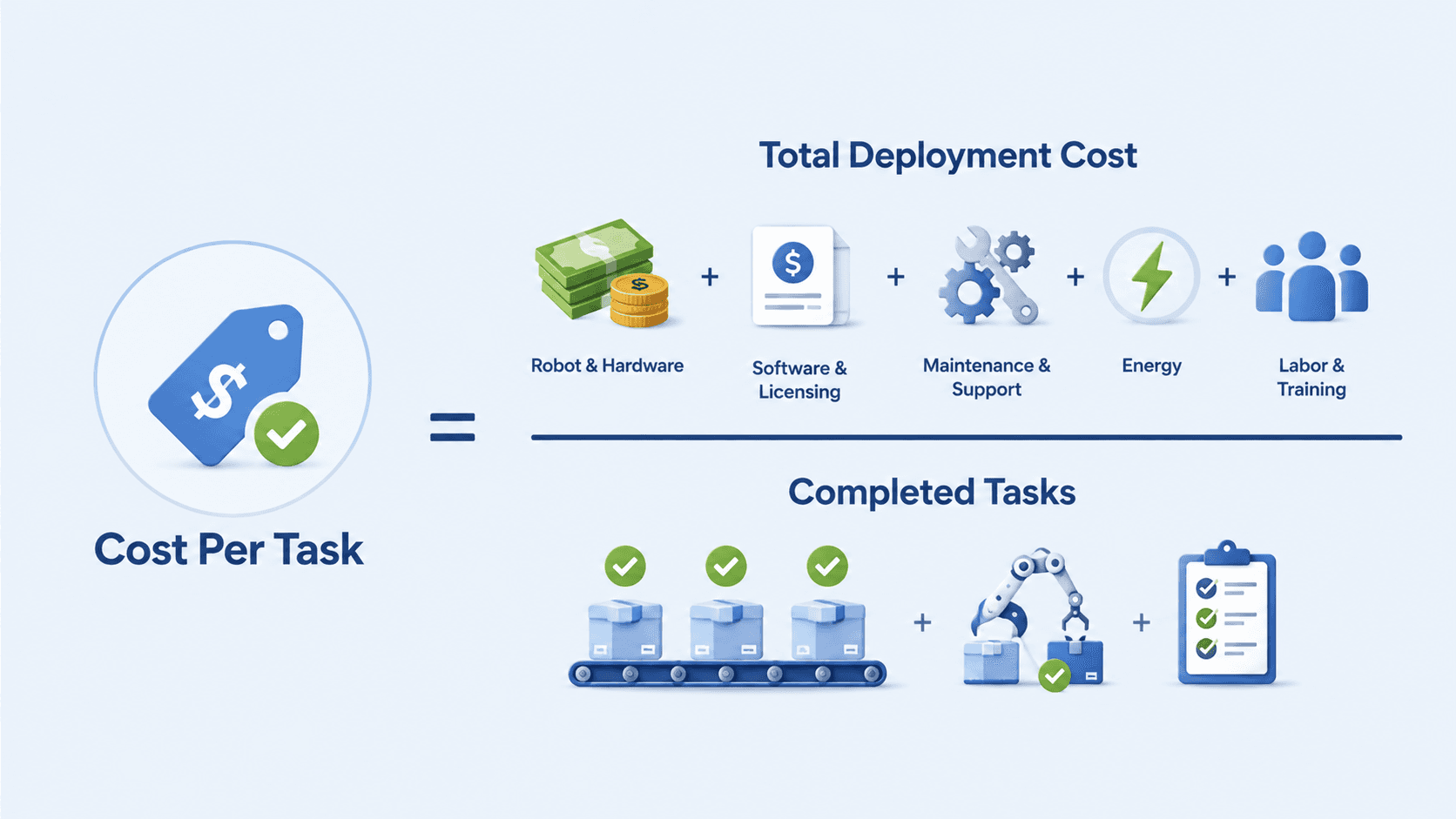
Once the unit is clear, the calculation becomes more useful. Take the full cost of operating the robot over a meaningful period and divide it by the number of successfully completed tasks. The exact accounting can vary, but the principle is simple: measure what it costs to produce a useful outcome.
That number can then be compared with the current process. If the existing workflow costs eight dollars per inspection and a robot can perform the same inspection for three dollars at acceptable quality, the business case starts becoming much easier to explain.
The hidden costs belong in the numerator
A realistic cost-per-task calculation includes more than the purchase price. Maintenance, charging, software, connectivity, operator time, consumables, downtime, training, support, and expected useful life can all change the result.
Human intervention is especially important. A robot may technically complete one hundred tasks a day, but if an employee has to reset, redirect, or rescue it every few minutes, that labor belongs in the cost. Autonomy should not be treated as free simply because the machine moved on its own most of the time.
Utilization changes the denominator. A robot that sits idle for most of the day spreads its fixed costs across fewer useful tasks. A machine that is consistently productive spreads those costs across more output. That is why a cheaper robot with weak utilization can end up more expensive per task.
For procurement teams, this metric is powerful because it creates a common language. Engineers may care about sensors and autonomy stacks. Operations teams may care about throughput and reliability. Finance cares about cost. Cost per task connects all three.
RobotifyX can eventually make this comparison much easier by helping buyers evaluate machines around real operating metrics rather than product categories alone. The useful question is not “Which robot is cheapest?” It is “Which robot gets this job done at the best total cost with acceptable reliability?”
The marketplace to buy, rent, and hire robots.
Discover robotics systems and services across industries, capabilities, and real-world applications.
Explore RobotifyX